
Disclaimer: Despite working in technology for at least 4 decades, prior to now, we've never owned or operated a generator of any kind despite being fully aware of their purpose and use coming from the Deep South. In fact, have never used any device that used propane...but we understand that "propane is God's gas."
TL;DR: This looks to be a pretty impressive feat of engineering; but there are small annoyances and grossly insufficient instructions plus a severe lack of online information.
It's made worse by Ecoflow's terrible product naming; everything online is about the "Dual Fuel Generator 3000" (which looks like a DELTA Pro unit) and not the "Smart Generator 4000" (otherwise called the "Dual Fuel Generator 4000", which looks like an actual generator in a slightly larger DELTA Pro 3 shell.)
But it does have creativity in its use case.
Don't you have a Smart Home Panel 2 and batteries? Why the generator?
Valid questions. Here's the truth.
We use ~15-20kWh every day in non-summer months. That's lower than the US average. We moved basically every circuit over except for the dryer (only used on weekends) and one bathroom outlet (only used in the evenings). So basically we're 100% off-peak pricing.
That meant instead of a $300/month bill like normal, we just got a bill that asked for no money due, because we had a bill credit of $100 and used $100 worth of energy charged. Not bad. (Disclaimer: swapping out the two gas appliances helped on the gas side substantially, especially the water heater, which turned into a high efficiency tankless that takes less electricity than a plug-in fan.)
We also set up a solar array that, in optimum conditions, can generate between 800w - 1000w of power, offsetting consumption during on-peak.
So yes, in terms of controlling cost overall, we're good. We've got 99 Problems and a (utility) bill isn't one.
However...that doesn't perfectly address extended outage situations OR times where consumption needed to exceed capacity for whatever reason.
Adding capacity technically means either (A) adding a DELTA Pro Ultra for over $3k or (B) switching to at least two DELTA Pro 3s for $5k. We confirmed with Ecoflow that despite what another Redditor was told, you cannot connect more than one Double Voltage Hub/2xDELTA Pro units to the Smart Home Panel 2. Means 21kWh is all you get unless you get a Pro Ultra OR swap the Pros for Pro 3's (which support the Pro Extra Batteries). Which might be an option in the future, but we thought about it: if the concern is really about runtime vs. capacity, why not just get something to extend the existing runtime?
Generator became a possible answer. And to your next question:
Why not just get any ol generator with a transfer switch/input box/etc.? Why Ecoflow's?
Another good question.
Doing the transfer switch/input box method creates manual steps with the panel. If we have to do manual steps, there's not much real difference. We got the Smart Generator 4000 for $1100 once we figured out the Ecoflow site's pricing trick, which is comparable price to decently strong regular generators.
Now, connecting the Smart Generator to the main DELTA Pro units means you're losing one of the batteries; because it's basically moot, you're powering it. But when you're using the Double Voltage Hub with two Pros, charging one Pro doesn't trickle over to the other; so you're still running around reconnecting cables to each unit. Smart Home Panel 2 will try to use one unit to its full potential; but it needs both legs to power 240v circuits (US).
So the key is, we need both Pros to have sufficient capacity. But we needed a way to give that capacity without losing their current ability to run the home's power.
So...we got creative.
This created a new option, one that appeals strongly: rather than worry about the limitations of connecting the Generator to the DELTA Pro while still powering the house, why not just let the Generator recharge batteries as needed, since there's manual steps anyway?
For us, since it's about temporarily extending runtime vs. directly powering the house, one thing the Ecoflow Smart Generators can do that other generators cannot, is to charge the extra batteries by themselves. Meaning, you can just take a battery out back to the generator to recharge it as needed. Unplug it from one of the DELTA Pro units, plug it straight into the Generator, let the Generator top it up real quick, then add it back to the setup. The Extra Battery has smarts inside that let it tell the Generator what speeds it can charge in and even when it's okay to start running. This was frankly impressive. Especially since after doing so the Generator showed up automatically in the app and was fully controllable with no extra hoops needed.
Now, yet another new option showed up. We could just buy one or two spare DELTA Pro Extra Batteries (currently dirt cheap at $1100 each) and swap them around. Recharge with the Generator in a pinch. This then lessens how much propane/gas/etc. is needed if the outage is lasting more than a day, based on our "max comfort" consumption.
The Generator also works straightaway with the DELTA 2 Max Extra Battery (i.e. no adapter), meaning that we can also keep "Main" (our OG DELTA 2 Max that basically powers everything before the downstairs units kick in) topped up in the same way. Main is 6kWh of separate runtime for things that aren't hardwired to preserve consumption of the downstairs DELTA Pros to only that which cannot be plugged in, such as the furnace (quite important in winter) where the furnace and lighting can be fully served for at least two days without really needing to ever touch the Generator.
That only leaves the security system which is tied to the exterior lighting circuits, and that specific circuit takes less than 50w. Meaning we can just cut off consumption to non-essential circuits such as the kitchen (there's another DELTA 2 Max that can power all of those devices anyway; we did plug the microwave in just so it was a separate circuit from the air fryer/coffee maker/toaster/kettle...but in a pinch the DELTA 3 Max Plus ("Internet") could take its place as it has a higher surge rating.)
Even in the slim situations the Generator needed to be called to action, it was able to charge up a DELTA Pro Extra Battery with minimal propane consumption, yet that extra 3.6 kWh is easily 8 hours of run for the bare essentials in winter, for just one battery. Summer is obviously a completely different story, but using the portable floor unit in one room gives 10 hours of run if "Main" is used first, then we can recharge Main's batteries as needed for an additional 3-4 hours of run while the downstairs takes care of everything else and just not use central AC until power is restored.
In other words, the Extra Batteries are smart enough that they can make good use of the Generator for swapping if the grid is down. You can't charge Extra Batteries with non-Ecoflow hardware; so if you're already in the ecosystem, the Generator gives you more flexibility than a standard generator can.
But the Generator's documentation seems lacking.
We noticed that the dipstick was wet; which to an untrained eye would say that there's oil in it. There's not; you'd want to wipe the dipstick, but a newbie won't necessarily think to do that.
Second, the instructions indicate that the engine can take half a quart. After filling half a quart the included dipstick didn't seem to indicate much progress. After starting it up, it threw an error code indicating that more oil was needed. Having a transparent tank indicator off to the side would have helped a bit.
But also, there are pipettes inside that, in our unit, were completely disconnected and hanging loose. They're not discussed anywhere in the manual. We had to view one of the YouTube videos and pause when he started talking about the inners to try and see how his was expected to be connected:
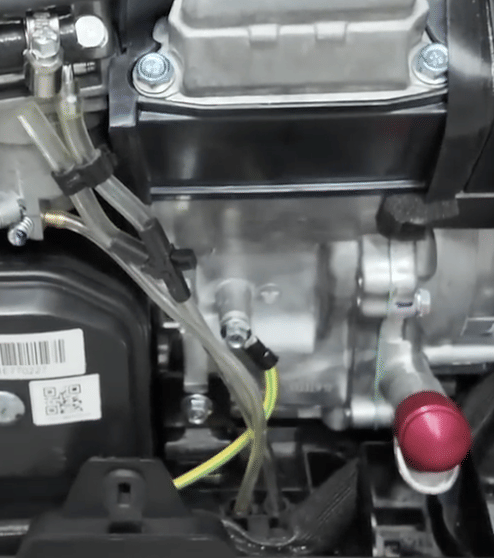
In ours, fresh out of the box, the black y-splitter in the middle wasn't inside the pipette, and neither of the two bottom pipettes were set into the bottom two holes. They were all just hanging loose for no clear reason we could determine. Maybe that's okay, maybe it's not. We're calling it out either way as a potential concern. If the connection is important, someone new might try to start up the unit without knowing they needed to be connected. If they're not important, securing them at least (so they're not just freely dangling) is ideal.
There are quieter generators, but it's not "loud" loud. More like "rickety" loud.
The vast majority of noise was coming from the muffler in the rear, but in general, it wasn't obscenely loud; arguably quieter than our EGO Lawn Mower, so that in of itself is impressive. But it certainly didn't sound like a clean running engine; it performed like some 80's biker's "hog", rickety and not smooth. For comparison, we have a 2016 Kia Soul which has a 1.5L engine, and while it's generally loud, even that engine is significantly quieter than the Smart Generator 4000. We're not past the break-in period yet; so it's possible it will smooth out, but to be honest: it makes us wish that MotorUp didn't go out of business, because that stuff worked. We digress.
Summary
Yes, it's true that people can spend $10k+ and avoid the need to do the vast majority of the above by tying a Generator with a Pro Ultra.
What a lot of people don't take into account is that the DELTA Pro Ultra series is just too large, heavy, bulky, etc. for the routine especially if your consumption doesn't really warrant it. Not everyone has a big, spacious garage like Ecoflow's marketing shows. In fact, were it not for the central AC and/or humidifier vs. dehumidifier (which are basically ACs themselves) - and this has been tested countless times - our property could theoretically run for 2 days on just battery. Most generators could also do that, but do you really want to hear it running for 48 hours straight?
The price of the DELTA Pro and its batteries are rock bottom. If you have just basic capacity needs, they're perfectly fine units with the Smart Home Panel 2 (once you get past software frustrations). And you can buy them over time as you need to add capacity, vs. the significant upfront hit.
The only real downside is, if you care, the lower clean energy tax credits, because that's based on capacity installed, not when you bought it.
The Generator can either power your home if you choose, or just power the batteries that power your home. Doing the latter option is a substantial cost savings upfront vs. the former.