
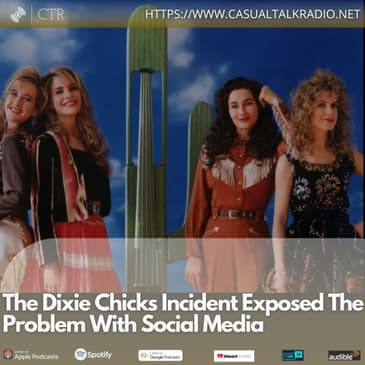
The Dixie Chicks Incident Exposed The Problem With Social Media
Follow CTR and Casual Talk Radio:
Website: https://www.CasualTalkRadio.net
Twitter: @CasualTalkRadio
Facebook: @ThisIsCTR
[00:00:04] You're listening to Casual Talk Radio, where common sense is still the norm.
[00:00:10] Whether you're a new or long-time listener, we appreciate you joining us today.
[00:00:14] Visit us at CasualTalkRadio.net.
[00:00:17] And now, here's your host, Leistor.
[00:00:21] I gotta say, you know, being a technologist that I am, it really is disheartening, truly disheartening
[00:00:29] to see how online is being abused, online of course being the internet.
[00:00:34] It's not what it was supposed to be.
[00:00:36] And I wanted to talk about it because I saw some troubling stuff happen and I heard about some troubling stuff that I had remembered vaguely,
[00:00:46] but I didn't recall the deeds until I went and did some digging.
[00:00:50] And just for those new welcome, by the way, I am telling a story from a technologist's perspective about online, internet, social media,
[00:01:00] everything having to do with the internet.
[00:01:02] I gotta take you back in time.
[00:01:04] We've got a time travel you.
[00:01:07] Online used to be nothing more than a phone signal, you know, and you would get connected.
[00:01:13] Usually it was through CompuServe or America Online later or directly to your work.
[00:01:20] So people might work from home every now and then and they're connecting to their work system to download simple papers.
[00:01:27] I mean, we take this for granted now, but at the time it was much simpler in its use.
[00:01:33] Over time, internet started to evolve the onset of email, true email.
[00:01:40] Photo sharing, online movies.
[00:01:43] More and more content becomes a thing.
[00:01:46] Online message boards become a thing.
[00:01:49] Online chat becomes a thing.
[00:01:51] Chatting over video becomes somewhat of a thing.
[00:01:54] It was very rudimentary and what it was.
[00:01:58] But internet was never intended to be the be all end all of interactions.
[00:02:04] It was really meant to use as a utility.
[00:02:07] You use it to find jobs.
[00:02:08] You use it to shop online.
[00:02:10] You use it to do something.
[00:02:12] Not that it was going to dominate one's life as it seems to have become.
[00:02:17] Online internet never was intended to dominate one's life.
[00:02:23] Fast forward, I was watching a one of the De Chappelle segments and he was reflecting about what happened to the Dixie chicks.
[00:02:33] And for those that don't remember or don't recall or don't know.
[00:02:36] The Dixie chicks that were a country music band are they're now known as the chicks, which I think is a terrible name.
[00:02:42] But the Dixie chicks were a country music band.
[00:02:45] I believe they held the record.
[00:02:48] They might still do of the best selling female group band.
[00:02:53] And so then the lead singer made a comment.
[00:02:57] This is what during George Bush, George Bush was supporting war in Iraq and the lead singer.
[00:03:05] They were overseas in the UK and they were basically saying, well, we're on your side and we don't.
[00:03:11] Something to the effect of, you know, we're ashamed that the president's also in Texas where they're from.
[00:03:16] The Dixie chicks got canceled for that statement.
[00:03:19] I mean, it was bad.
[00:03:20] The radio stopped playing their music because so many people called in absolutely pissed off that these were anti-American people.
[00:03:28] Because it was a patriotic time.
[00:03:31] It was a time when the president could do no wrong and all we were doing was following what the president would say, which is ironic.
[00:03:38] Since we come to this point now where we distrust our president, regardless, they got completely canceled.
[00:03:44] There were people burning their CDs.
[00:03:47] It was bad.
[00:03:48] They go into hiding for 14 years.
[00:03:51] They had done an Ellen DeGeneres interview and they said that essentially they went to become stay home moms.
[00:03:57] Take care of the kids, see their kids grow up and kind of hide because they were getting death threats.
[00:04:02] They had to go away.
[00:04:05] They had to just completely get out of the limelight.
[00:04:11] And when you reflect on what she said, she didn't say anything that was that bad.
[00:04:16] She basically said that they were anti-war.
[00:04:19] Well, we had always had anti-war segments in history in the 60s.
[00:04:23] There were anti-war segments in the 70s or anti-war segments.
[00:04:26] We always had anti-war protesting.
[00:04:29] Anti-war was actually the mainstream for a very long time.
[00:04:34] So when this happened to them and seeing the flag that they got, it was bad.
[00:04:39] It was shocking.
[00:04:40] Reminds me of Kanye West.
[00:04:42] George Bush doesn't care about black people.
[00:04:44] When he does that, that was a telethon and he's up there with Mike Myers and Mike Myers is talking about what's happening to the people getting flooded.
[00:04:51] And then Kanye just blurts this out in the middle of nothing.
[00:04:54] We would learn later that was not scripted.
[00:04:58] Mike Myers was proud of him for saying it, but he couldn't do anything because he's on the spot here.
[00:05:03] Chris Tucker was there and Chris Tucker was like, man, what's going on?
[00:05:06] But Kanye, he for a moment got canceled for the same thing.
[00:05:09] There was this aura of can do no wrong around George Bush that made no damn sense because if you look back at presidents past, both Bushes seemed like they didn't know what the fuck they were doing.
[00:05:21] And I didn't know if there was something that changed around sentiment that would cause what happened to the Dixie chicks later around George Bush because what they said was actually the reaction was the polar opposite of what I would have expected.
[00:05:35] Given again, we historically have been anti-war and then all of a sudden being anti-war was bad or if it's just because they didn't insult the guy.
[00:05:43] They just say we're ashamed that he comes from Texas.
[00:05:45] The most benign thing fast forward.
[00:05:47] And now you look at the kind of things people are getting canceled for.
[00:05:51] Some of the stuff silly, some of the stuff is legit holding up the severed head of the current president.
[00:05:56] Yeah, you probably should be getting canceled for something like that.
[00:05:59] But saying things like, hey, the president's an idiot or something else and then you get other people and they don't get canceled for inciting violence for trashing somebody for insulting somebody or insulting somebody's appearance and they don't get canceled.
[00:06:13] So now we're picking and choosing when we're going to cancel certain people.
[00:06:17] Now we get to this world where we're steering a narrative.
[00:06:20] We want a certain narrative to dominate the waves in complete disregard to every other voice that's out there, which is what ultimately spurred Elon Musk to take over Twitter slash X because he saw there was a whole mess of censorship happening to people on Twitter and that legit was happening.
[00:06:39] So as I'm listening to this Dixie chick story and the Deja Pels story because he got canceled with the whole trans jokes that he did and the Netflix thing and all the people that would get rosy, right?
[00:06:53] All the people that were getting canceled over time.
[00:06:57] I realized, you know, the Internet, I always, I have a saying and that is that the Internet social media.
[00:07:04] I should be more clear.
[00:07:05] Social media gave certain people a voice that shouldn't have one.
[00:07:09] They probably shouldn't have one because there are some people who should not be allowed to speak out on that platform with the level of influence that they do.
[00:07:18] But I more blame the people who are taking action as a result of those voices.
[00:07:25] A lot of the current political spectrum looks at social media and they use it as a compass to guide what they're going to do.
[00:07:34] They believe that's the majority voice used to be that we would do polls.
[00:07:39] The poll might be some lady walking in the mall somewhere who would intercept you, pull you to a side room and ask you a bunch of questions.
[00:07:46] Could be those people walking door to door.
[00:07:49] Could be a mailer that was sent to your place.
[00:07:51] Could be a call in the olden days they might call you.
[00:07:54] Point is, they would actually actively outreach to every level, not just libertarian or conservative or whatever.
[00:08:03] They would try to reach out to everybody in their constituency because they wanted to understand the totality of voices in their sphere of influence.
[00:08:11] Social media is a small fraction of the world.
[00:08:14] They happen to be the loudest, but they're a small fraction of the world.
[00:08:18] When you cater to the loudest at the expense of everybody else, we end up with the chaos that we ended up with this last four years under Joe Biden.
[00:08:27] Because that's what happened.
[00:08:28] A bunch of people, largely social media, were set off by mean tweets and they voted Donald Trump out of office.
[00:08:34] That's what happened.
[00:08:36] Nobody voted for Joe Biden because of his policies.
[00:08:38] He didn't campaign on policies.
[00:08:40] He didn't hardly campaign at all.
[00:08:41] Tulsi Gabbard and, by the way, Kamala Harris both schooled that man on the stage.
[00:08:48] Bernie Sanders was populist.
[00:08:51] He was the more popular candidate and yet did not get enough votes.
[00:08:55] Kamala did not get she hard to got any votes at all.
[00:08:58] Tulsi didn't get enough votes.
[00:09:00] Multiple people dropped out of the race before they even have tried.
[00:09:04] They limped him over the finish line because he was aligned with Obama and people liked Obama as a person.
[00:09:10] Nobody supported Obama because of his policies.
[00:09:13] They supported him because he's black.
[00:09:15] So now social media is at once again at the forefront where we're listening to those voices, though they be the minority voices.
[00:09:24] We're listening to them at the expense of other people.
[00:09:27] And what's happened is we've, they term it polarized.
[00:09:31] It's not polarized because of any one side.
[00:09:34] It's polarized because of all sides.
[00:09:36] It's polarized because we've allowed social media to guide the narrative because there are people on social media who have voices.
[00:09:43] You probably shouldn't have voices.
[00:09:45] The downstream effect suicide rates for young people.
[00:09:49] I don't know if anybody's paying attention other than myself, but we saw a significant spike in suicides among young people.
[00:09:56] I'll tell you a secret.
[00:09:57] I watched a young girl hang herself.
[00:10:00] I watched it happen from the moment she walked into her backyard to the moment she put the noose around her neck to the moment she climbed upon the chair to the moment she kicked the chair away and watched her body squirm for the very last time.
[00:10:16] And as her device continued recording and people came looking for her calling her name prior to not be not knowing where she was because she's in the middle of nowhere.
[00:10:26] I watched that happen.
[00:10:28] I watched a young man.
[00:10:29] High on drugs break into a car dealership for no reason and the cops gunned him down.
[00:10:36] I watched two girls go at it fighting only to get shot by cops simply because they were fighting.
[00:10:44] My point, there's more violence, but there's also more suicides.
[00:10:51] There's more unrest.
[00:10:52] There's less satisfaction.
[00:10:54] I said that financial stability is not to be seen.
[00:10:57] People's confidence is not there.
[00:10:59] It's harder to do things.
[00:11:00] I had an argument.
[00:11:02] I'll call this an argument, not a spirit of conversation.
[00:11:05] I had an argument with somebody about housing.
[00:11:07] I have said and I'll maintain renting as a scam.
[00:11:11] Why is renting a scam?
[00:11:13] It's a scam because they know they can charge whatever the F they want if it's a state that has no rent control.
[00:11:20] Many states choose not to implement rent control because they know that the cost of property and taxes and everything skyrockets.
[00:11:29] It's all a big scam.
[00:11:31] So the state wants to get more money.
[00:11:32] And so they allow these property owners to charge more to these people.
[00:11:38] It's a big scam.
[00:11:39] Essentially is what it is.
[00:11:40] So now you're watching this and you're like, well, wait a minute.
[00:11:44] We're supposed to these people are supposed to make a good living.
[00:11:48] So it's hard to get a job in the front.
[00:11:51] It's hard to get a job.
[00:11:52] It's expensive to go to college because it is.
[00:11:56] And you expect them to pay increasing rents that are not commensurate with the rise of salaries on the college side.
[00:12:05] Joe Biden's save plan, which was a plan that essentially was letting people not have to pay their school bill.
[00:12:11] Right.
[00:12:13] Got shot down by a court.
[00:12:15] Of course it was getting shot down.
[00:12:16] It was unconstitutional.
[00:12:17] Only Congress can do it.
[00:12:18] Congress has not wanted to do it.
[00:12:21] So Joe Biden takes action because he's this close to an election.
[00:12:23] He was trying to win some brownie points of people.
[00:12:26] Judge shoots it down.
[00:12:27] So then the servicer has to roll back if you were eligible for it.
[00:12:31] You might be eligible for it.
[00:12:32] It doesn't matter.
[00:12:33] You're not going to get it because the judge won't let it happen because Congress has to do it.
[00:12:37] Congress doesn't want to do it.
[00:12:38] Do you know what Congress is spending time on?
[00:12:40] Congress is spending time on an omnibus bill, basically a CR.
[00:12:45] And the CR is cramming a whole bunch of stuff in there, including the integrity of the voting system.
[00:12:51] So while they're arguing about whether or not you should be forced to validate who you are in order to be allowed to vote to make sure you're a legal citizen,
[00:12:59] they're arguing about that nonsense.
[00:13:01] You if you take student loans, which you're entitled to by the way, if you take student loans, you expect to pay those back.
[00:13:08] Sure, no problem.
[00:13:10] But under a system where the salaries are not increasing, commensurate with these expenses.
[00:13:15] Second, it's not easy to get a job in the first place.
[00:13:18] And third, many companies discriminate against you to even get those levels of jobs if you don't have the college degree, which creates a chicken in the egg.
[00:13:25] And on top of this, you have the hiring process.
[00:13:28] The hiring process is slanted against the applicant.
[00:13:31] They're what often companies will do and I've seen it time and again and I try to fight it.
[00:13:36] Not only one person, they'll go out and try to find somebody very specific.
[00:13:41] They're not trying to be open about who they get.
[00:13:44] They're looking for somebody already.
[00:13:45] They got somebody in mind.
[00:13:47] That's bias, but they do it anyway.
[00:13:49] How does this connect to social media?
[00:13:52] It connects the social media in one key way.
[00:13:55] Social media, the voices that are put out there, the vast majority of the time, those are the people who are steering the kind of conversations that cause the very discrimination and the bias that I'm describing.
[00:14:06] Because these people who are on the hiring side see how that is.
[00:14:10] They see, these are the dissenters.
[00:14:13] These are the troublemakers.
[00:14:14] These are the ones that are going to cause a problem for my business.
[00:14:17] So we need to make sure we don't hire those kinds of people.
[00:14:20] Certain personality traits that they look for and they want to try to avoid.
[00:14:25] And so they do everything in their power to make sure not to hire those people.
[00:14:29] That impacts you because I met a gal and she, I could tell was an extrovert, clearly extrovert.
[00:14:34] Nice gal, but she talked too much.
[00:14:36] Bottom line, she talked too much.
[00:14:38] Very brilliant.
[00:14:39] She knew her stuff.
[00:14:40] I knew she would surpass me in terms of skill level at some point later.
[00:14:45] She's young gal, but she needed mentorship.
[00:14:48] She needed somebody to sit with her and help her understand.
[00:14:51] There's a way to deliver your message so that it's direct and to the point so you don't lose your audience.
[00:14:56] That's a skill and it's trainable.
[00:14:59] But you have to have somebody who mentors you and why it matters.
[00:15:02] It doesn't mean you have to turn yourself off completely in life.
[00:15:05] But when you're in the workspace, you do have to cater your message to your target audience.
[00:15:09] And I knew she'd be a superstar.
[00:15:11] They completely passed her up because she didn't have core experience in the department and in the vertical market,
[00:15:17] which I think is stupid because you can always train those things.
[00:15:21] This came because I know in social media circles, you see these kind of people who just chat and talk and talk
[00:15:28] and they share too much.
[00:15:29] They talk too much and they don't listen.
[00:15:31] And they say like after every sentence or they're indecisive about the words that they use.
[00:15:37] It's hard to get a straight answer out of people.
[00:15:39] That's a social media byproduct.
[00:15:42] It's a byproduct of the era that we've been pushed into with social media changing the way your voice comes across.
[00:15:51] Unfortunately, when we see that reaction from the businesses where they're not hiring those people because of these traits that they've detected out of people.
[00:15:59] It causes those same voices to go back on social media and get even louder because now they don't have anything to occupy their time and properly distract them.
[00:16:08] So since they're not occupied and distracted, they go online to social media so they can communicate however they communicate to other people.
[00:16:17] Meanwhile, you have a tug of war going on.
[00:16:20] The businesses really need to find people, but they're hesitant to hire certain people based on social media presence.
[00:16:27] Social media presence as in I see there's certain types of people out there and I'm purposely not looking for those people.
[00:16:34] Those people then are able to lend their voice to every single cause that helps them occupy their time and helps them feel good about themselves.
[00:16:42] And then leadership in the government looks at that because they don't know any better and they use that to guide the country.
[00:16:49] So all the decisions that you see are downstream impact.
[00:16:53] I just saw somebody talking about the outrage over Ukraine and sending money Ukraine.
[00:16:58] It's fake because it's all used instruments and used weaponry.
[00:17:01] It's not all used weapons and use, you know, instruments because if you understand the way the CRs work, you understand that there's a line item that talks about funding sent to Ukraine.
[00:17:13] And it literally is money sent to Ukraine.
[00:17:15] So it's not fair to pigeonhole say no, we're only sending used weapons.
[00:17:21] It's not really money.
[00:17:22] No, this is somebody doesn't understand real money is being sent to Ukraine.
[00:17:27] The main reason that there is support for sending money to Ukraine is because of voices on social media who show solidarity for Ukraine.
[00:17:36] Nobody says that we shouldn't show solidarity for Ukraine during times of war.
[00:17:40] However, some of the conservative voices say that we probably should not be getting in that business because it's ultimately a war between Ukraine and Russia.
[00:17:48] And we shouldn't be in the middle of that.
[00:17:51] If we're going to be involved, we should be actively trying to stop it.
[00:17:54] Trying to stop it means we may need to concede because of the position we put ourselves in, which is a weakening position.
[00:18:01] People on social media don't want to do that.
[00:18:04] People on social media would rather just fund and put ourselves at risk and they don't understand.
[00:18:09] Then if we get attacked, what happens?
[00:18:13] All those same people then blame the government for not protecting us.
[00:18:17] Not understanding that a lot of the money that gets set aside in these CRs actually goes to our military.
[00:18:22] In fact, it's the largest expense we have.
[00:18:25] My summary, a lot of what's happening on social media, a lot of the chatter, a lot of the resistance and a lot of the fighting and a lot of the agitation
[00:18:33] is because people don't take the time to learn our system.
[00:18:36] And because they don't learn our system, they end up voting for the wrong people.
[00:18:40] When they vote for the wrong people, they then lend their voice to the wrong things because they don't understand.
[00:18:47] They don't understand.
[00:18:49] We already spend crap tons for military.
[00:18:51] We are sending money directly to Ukraine where we really probably shouldn't be.
[00:18:56] All of these things that Joe Biden was responsible for on an international scale contributed to the war situation we're in right now.
[00:19:04] The person who's trying to get in office now, which is Donald Trump when he was in office prior to the pandemic, none of the world leaders were able to step to him.
[00:19:13] Not a single one.
[00:19:15] You had calm, you had quiet peace happening on international because they were afraid of him.
[00:19:20] He gets attacked because he's xenophobic because those same people don't understand that unrest internationally affects us all.
[00:19:29] It affects our economy.
[00:19:31] It affects our way of life.
[00:19:32] It affects our jobs.
[00:19:33] It affects our all of our property because remember, you didn't know this, China owns portions of our property.
[00:19:43] International places own portions of our property.
[00:19:46] They own some of our debt.
[00:19:48] They own some of us.
[00:19:49] So any disruption, any disruption on the international affects us all, but they don't take the time to learn why that's the case.
[00:19:58] The reason I was able to get so much worse over a three and a half year span is because Biden purposely didn't do anything because he was too busy rolling back what Donald Trump did in terms of leaving the courts.
[00:20:13] Being part of that active push and put it putting the foot down and saying this is what we're going to do under Donald Trump is the reason we were able to get to a much calmer situation.
[00:20:24] And we left it because Joe Biden went the opposite direction.
[00:20:28] The voices that are chatting now about their anger or their frustration have only themselves to blame because they supported what's happening now because they didn't take the time to understand what you're supporting is the wrong answer because it's going to affect you.
[00:20:44] You don't think it does, but it's going to affect you.
[00:20:47] All of it's going to affect you.
[00:20:49] I don't think.
[00:20:51] Again, that Internet was ever designed to be a singular voice that the government acts upon and that's what it's become.
[00:21:00] But I also don't think that social media was intended to be a platform for people to voice their intent to commit suicide.
[00:21:08] I don't think that social media was ever intended for a lot of these celebrities to threaten each other.
[00:21:14] Like have you noticed that the celebrities are now against each other to people where you might have thought.
[00:21:18] That they were having each other's backs and they really are just as cutthroat as anybody else.
[00:21:23] Say what you will about 50 cent, maybe has all the best of intentions with the whole diddy situation, but that's cutthroat that he just collected information.
[00:21:31] Cat Williams says, you know, I'm not paying for that.
[00:21:34] I'm collecting all this information heads go down, you know, that he's got his own stockpiles.
[00:21:39] Say what you will about the motivation when I talk about motivation.
[00:21:42] We're not talking about the spirit of why you do it.
[00:21:44] I'm talking simply the bare basic that this celebrity is not aligned with this celebrity.
[00:21:50] And that was not at least on the surface, the case prior to the onset of social media.
[00:21:55] All of a sudden it seems like they're all against each other and they can't really trust each other.
[00:21:59] Notice that nobody really trusts Oprah now when at one point she was one of the more trustworthy right alongside Larry King.
[00:22:07] What happened? I don't know.
[00:22:09] But I there's a correlation at least with the onset of social media.
[00:22:13] And the fact that perhaps it's turning people against each other because some people shouldn't have a voice and some people are on social media.
[00:22:22] That probably shouldn't be there are people that were some of the nicest people walking before social media.
[00:22:28] Alyssa Milano comes to mind one of the nicest girls you ever did meet.
[00:22:33] Social media comes around and she turns into a stark raving lunatic out of thin air because she is given a platform and a voice that she probably shouldn't have.
[00:22:41] And she no longer has her manager or publicist and all these people to help corral her and help her understand.
[00:22:49] There's certain things you really shouldn't be doing.
[00:22:53] I am not this episode is not to change anybody's mind about anything.
[00:22:57] It was simply to put out a voice to say I'm disappointed to see the internet used misused in this fashion.
[00:23:05] I'm disappointed to see that there was we went the complete polar opposite of what it was intended to do.
[00:23:11] And I'm disappointed to see that there was no way to be used as a utility for these different services.
[00:23:15] I don't think it's meant to be the be all end all of somebody's world.
[00:23:19] And just for the record, I am not on social media.
[00:23:23] I completely said screw you to LinkedIn years ago.
[00:23:27] I'm not on Facebook.
[00:23:29] I'm not on the X Twitter.
[00:23:31] I'm not I have never been on Instagram.
[00:23:34] Never been on Tiktok and refused to I'm not any social media on purpose because it's a waste of time.
[00:23:40] Number one, number two, what I just said voices that probably shouldn't have a voice.
[00:23:45] And that's all they do is talk about whatever they want to steer somebody to.
[00:23:49] I don't feel that I should allow myself to be influenced by that negative.
[00:23:56] You know, smoke that that spins around all social media.
[00:24:00] That's all it is is negative smoke plus the platforms themselves.
[00:24:04] Social media platforms that steer content your way designed to set off your emotions.
[00:24:10] You're designed to get your voice because they want your engagement.
[00:24:14] All of them working together, just like the movie, The Matrix in a way and I sense it.
[00:24:19] But maybe that's just because I work technology.
[00:24:21] It was easier for me to sense it where everybody else around me seems to have embraced it.
[00:24:26] That's cool if you want to do that.
[00:24:27] Me, I'm with the good old telephone.
[00:24:30] Mind you, time is slim.
[00:24:32] But when possible, I'm with the good old telephone doing my own thing and making sure there's a roof over the head.
[00:24:39] Food on the table, you know, taking care of my lawn, taking care of my client.
[00:24:45] At some point, taking care of my health.
[00:24:48] At some point, getting back to reading because I'm got a backlog of books that I'd love to get through.
[00:24:53] You know, important things again, not the social media stuff, not for me.
[00:24:58] Might be for you. It's not for me.
[00:25:00] I hope I hope we get tired of it.
[00:25:03] I hope society gets tired of it.
[00:25:05] I know he won't.
[00:25:06] I would hope that society gets tired of social media.
[00:25:08] I hope that we get somehow, because I do think that it is going to become a mental health crisis.
[00:25:14] The reliance on social media for news, the reliance on social media for updates, the persistent need to be live and active, the text message reliance.
[00:25:23] Everything has to be immediate and now an urgent.
[00:25:27] I would think there's some case to be made about a mental health crisis upon us spurred by this reliance on technology that I don't fully understand as a technologist myself.
[00:25:39] I think it's stupid. Why would you want to serve a computer?
[00:25:43] We used to joke about it all the time and then now it's the reality and nobody seems to sense it but me.
[00:25:49] So if I have had any impact whatsoever, I guess I will create a call to action.
[00:25:54] If I've had any impact in what I talked about, if I had caused you to think even just a little bit.
[00:26:00] It's easy. I think it's easy. Right?
[00:26:05] Ask yourself why you feel the need to immediately respond to something.
[00:26:11] Ask yourself why you prefer to set a text message over talking to someone on the phone.
[00:26:17] Ask yourself what's so wrong with email since it goes at the same speed as text messages.
[00:26:23] Ask yourself why you can't just go visit somebody instead of sending them a text when they're a few miles away.
[00:26:30] And most important, ask yourself why you have to be staring at your phone the vast majority of the day.
[00:26:38] If you can come up with an answer then fix it.
[00:26:41] Do the opposite. Stay away from it. Avoid it. Turn it off. Practice it.
[00:26:46] And eventually, hopefully you might get tired of it and realize what I've been talking about.
[00:26:51] That you can survive without it and you might feel better without it.
[00:26:55] You might be happier without it. You might be more focused without it.
[00:26:58] This is my theory. I don't know your life but that would be my call to action is to at least try it.
[00:27:03] Try to live without the heavy reliance on tech.
[00:27:06] I'm not suggesting avoid it completely but the heavy reliance on it.
[00:27:09] Don't let it run you. It should serve you not run you.