
It's interesting to think back to the time when consumer battery storage simply wasn't a thing for the regular consumer.
EcoFlow's story is interesting. From humble beginnings in the drone space to early crowdfunding to becoming one of the most popular forms of energy independence; it started with a small vision, then got led by people who only focused on market saturation rather than market domination (yes, there's a difference).
When EcoFlow first showed up, there was obviously the Ankers and Duracells of the world, but the devices they offered weren't anywhere near what was being proposed in the crowdfunding for EcoFlow. The infamous DELTA Pro Kickstarter at the time (and may not have been surpassed since) raised a staggering $12 million, the highest Kickstarter at the time. That DELTA Pro is slightly different than the current model, but the current DELTA Pro remains the second most well-rounded device of the lineup.
The reason that Kickstarter was so successful: it created a product that served many different needs and people clearly saw its value in multiple spaces. Fast forward and the value of these types of devices remains undeniable; which then caught competitor eyes. EcoFlow had different levels like RIVER and DELTA that served different user groups; the competitors followed suit.
The problem with EcoFlow, is that at some point they lost sight of the "leader" position; and the strong theory is that they hooked into the rush of the Obama (and later Biden) Administration's green energy credit structure, thinking that it would help offset the price of their units and allow them to maximize profits, just like what happened with the EV market. But this happened at a cost: everyone else saw the same opportunity and jumped on it, which created a race to the bottom instead of true innovation in the space. Only recently has EcoFlow slightly course corrected, but some of their changes are frankly head-scratching.
Confusing Product Lines.
Anyone in the eco can clearly understand what's going on. But you'd have to be in it already. Someone on the outside is having an increasingly hard time understanding the vision. We'll help where we can, but even we struggle with it a bit.
RIVER is the "OG" line. It's a smaller unit that's designed to have enough capacity to power portable devices but not really intended to be tossed in a backpack or anything. A good image in your mind is a device sitting near your tent while you're out camping, helping to keep basic electrical (i.e. your cell phone) needs covered. Duracell is arguably one of the primary competitors here, but BLUETTI and Anker and quite a few others have released devices. In response, EcoFlow released RIVER 2, RIVER 2 Pro, RIVER 3, RIVER 3 Pro, RIVER 3 Plus, etc. More on that chaos later.
DELTA is the so-called "Cadillac" RIVER. It does what RIVER does and more, but with less portability and (for the most part) at least 5x the battery capacity (this is where the sprawl starts to show up; more on that later) and way more ports. DELTA was designed to support greater capacities and draw needs for house holds, and depending on the unit, can even power an RV on its own. Vast majority who buy EcoFlow are going to start here, not with the RIVER, because of the same issue that affected Apple with the iPad/iPod Touch/iPad Mini intersect (more on that later).
DELTA has models within this set; more on that (confusion) below.
RAPID is the battery pack. It's basically the same as other portable battery packs that you see all over the place with some fancy features. Mostly for charging your phone or tablet.
TRAIL is the newest, and the so-called "Cadillac" RAPID. Same as RAPID with more capacity, more ports, and tries to get closer to the maximum capacity allowed through TSA. This one is more suited for keeping laptops charged on the go - but the vast majority of travel mechanisms other than cars and walking have in-built charging available.
WAVE is basically a battery-powered air conditioner/space heater. It has its own limited batteries or can use one of the DELTA model Extra Batteries for longer run time.
GLACIER is a portable, battery-powered ice chest/cooler.
STREAM is (basically) a solar system with some battery storage that can feed back to grid if supported. For the United States only Utah (for bizarre reasons) can purchase this even though it's touted as a self-install with no electrician needed. STREAM cannot directly power any other type of device in the eco, but as it supports powering via AC, it can charge any device that recharges via AC.
OCEAN is EcoFlow's response to TESLA's Powerwall and Anker's Solix X1 - providing in most cases a fully grid-tied system that can take over all power functions including solar and EV charging features. OCEAN is the most controversial, because quotes have been in the $50k + range before credits that by the end of the year may no longer exist - so we suspect this line is going to struggle to move product, and the demise of those credits may have been the trigger for EcoFlow to pivot back to the DELTA series with some of the newer offerings.
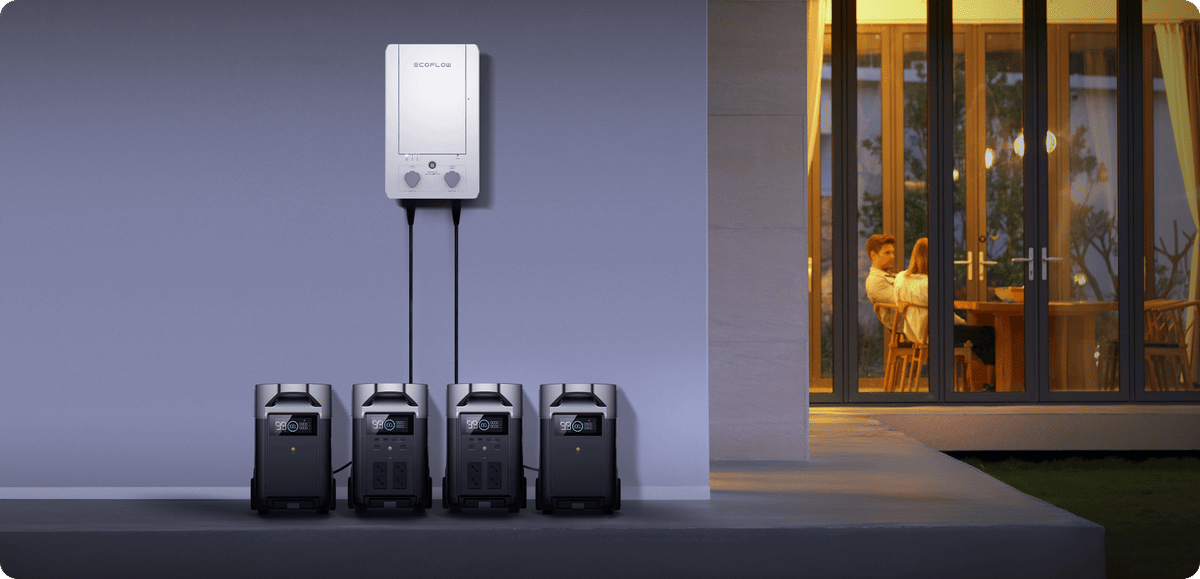
There are other products - the Smart Home Panels, the Smart Dual Fuel Generators, Smart Gateways, etc. But for the most part these are technically in the DELTA category, as the majority of them only work with DELTA units.
Even More Confusing Product Models.
So then within the DELTA series you have:
"Classic" (or for some units, no sub-name) DELTA
Pro
Which includes:
DELTA Pro
DELTA Pro 3 (there's no "2" for unknown reasons, and this is NOT part of the "3" line which is a different thing - more on that below)
Smart Home Panel
Smart Home Panel 2
Ultra
Which includes:
DELTA Pro Ultra
DELTA Pro Ultra X
Smart Home Panel 3
Smart Gateway
Max
Which includes:
DELTA Max (likely discontinued)
DELTA 2 Max
DELTA 3 Max (which frankly shouldn't be here as it's sorely lacking compared to the 2 Max)
Then, someone had the idea of a "Plus" subline:
DELTA 3 Ultra Plus
DELTA 3 Max Plus
DELTA 3 Plus
RIVER 3 Plus
The only difference between a unit that is "Plus" and one that isn't, is by and large, the Plus devices allow for things like expandability or additional non-standard ports, such as extra solar or Anderson ports.
The above is made further confusing by the fact that there are also product "families". This is basically the original naming convention and at one point represented the maturity of the products. We're focusing on the DELTA line here, not the RIVER, even though RIVER has a family concept of its own.
The "2" Series
Which includes:
DELTA 2
DELTA 2 Max
DELTA Pro (it doesn't make any sense, no.)
DELTA Pro 3 (no, it doesn't make any sense, we understand.)
Dual Fuel Generator 3000
Dual Fuel Generator 4000
Smart Home Panel
Smart Home Panel 2
The "3" Series
Which includes:
DELTA 3
DELTA 3 Plus
DELTA 3 Max
DELTA 3 Max Plus
DELTA 3 Ultra
The "Ultra" Series
Which includes:
DELTA Pro Ultra
DELTA Pro Ultra X
Smart Home Panel 3
Smart Gateway
The difference with these is the feature set. By and large the "3" Series is the most feature rich of the bunch, both in the app and on the devices. The "Ultra" series is about scalability and the "ultimate" in whole home setups. The "2" Series is arguably the most flexible but also limited.
But the other thing to note that isn't broadcast properly in any of the materials that EcoFlow publishes: Battery interoperability.
Compatibility of EcoFlow Batteries (DELTA)
The DELTA line is the only line with multiple sub-types. As such, people are often confused about what really supports what.
Some years back a person built a matrix that tried to outline this for people: https://www.linspyre.com/ecoholics/eb.html
After about a year it's been updated. But we noticed some inaccuracies.
Put simply: batteries are largely interchangeable with some exceptions, but you may need the Smart Generator Adapter (sold separately). The Linspyre link indicates some of this interop isn't possible, but it's been verified multiple times. So for example, you can take a DELTA Pro and connect a DELTA 2 Max battery; a DELTA 3 can take a DELTA 2 Max battery; a DELTA Pro 3 can take a DELTA Pro battery; and so on. The only family where this isn't really true is the Ultra series, where those batteries can only be used with other true Ultra models (remember, the "DELTA 3 Ultra" isn't an Ultra, it's a "3" Series.)
The limitation of interop extends then to the Smart Home Panel. The original Panel supported the DELTA Pro.
Panel 2 supports more devices, but not as you might think: it can take two DELTA Pros (only), two DELTA Pros and at least one Pro Ultra stack, or 1-3 DELTA Pro 3 units. DELTA Pro 3 cannot interop with the Panel 2 along with any other DELTA device, which is odd. However, the DELTA Pro 3 can use the DELTA Pro's Extra Batteries, meaning you don't completely lose out by upgrading (other than missing out on a few kWh of runtime). EcoFlow promised in writing that at some point the Pro and Pro 3 would be supported together; that hasn't happened. Chances are the hardware differences were too wide to make everything work seamlessly, so they gave up and just focused on Panel 3, thus making more sprawl.
Panel 3 is exclusive to the Pro Ultra X (at the moment).
Closing
The breakout above is not answering the title, is it? It actually is. You see, everyone in the market space is doing the same thing now. Anker has their own "Plus" chaos, BLUETTI has their own "family" concept, BLUETTI even copied the points system that EcoFlow has (and arguably is using the same website template to boot).
That's why EcoFlow pivoted into this bizarre naming structure - to try and keep apace with the competition. But we think that's a mistake.
The original family approach was easier for the regular consumer to digest, and a focus on interop with legacy devices would have driven brand loyalty. As-is, many would-be customers are turned off by the aggressive, overly confusing naming plus a lack of overall compatibility. This is on top of firmware-related issues trying to get many of the devices to play nice together.
EcoFlow has one tactical advantage over the others: using Anker as an example, their units do not support other unit-type batteries in their product suite. EcoFlow is the only provider of devices in the 2kWh+ range that we're aware of where it allows you to use the Extra Batteries with a variety of their other devices, even directly to their Smart Generator. That kind of seamless interop is what we feel EcoFlow should be focusing on - that and improving the overall experience for the Smart Home Panel and other devices, instead of just leaving things behind and letting them only be standalone units without the potential to be something much greater.