
Disclaimer: this is not talking about selling power back to the grid/grid-tied systems that cost in the mid five figure ranges. This is only talking about lowering the energy bill with a fairly realistic minimum investment.
In order to make this page make any sense we have to start with simple definitions. Chances are it's what people want to do - they just don't realize the term.
What is "Peak Shedding" aka "Load Shedding"?
Simple definition: you are "shedding" your electricity usage from on-peak priced to off-peak priced. This requires three things.
A "Time-of-Use" (TOU) Plan from your electric company.
At least in the US, almost all electric providers offer a TOU plan. It establishes a time range during the day where your rate is slightly higher, and the rest is significantly lower, than the "standard" plan would be.
Some providers automatically set you up with a TOU plan; others require you to specifically request it. Some carriers even let you choose from a variety of time ranges; so you can choose the range that best aligns with school and work schedules.
Battery storage technology - whether EcoFlow or otherwise.
The idea is to charge and store when it's cheap and use what's been stored when it's expensive. That requires the ability to store. Some areas get sufficient sun to where they can even do full solar to power devices directly without storing (but it's rare, and often costly, to generate enough solar to power everything all day. Can be done, but not common). With batteries, you can use stored energy and make use of solar above and beyond to offset consumption.
A very good understanding of your property's daily consumption.
The average household uses approximately 30 kilowatt hours (kWh) of electricity per day; but that makes a lot of assumptions, such as the presence of gas appliances for the heavy duty items. Before trying to load shed, you need to understand what it takes to power your home. There are various tools such as Sense that can help with this analysis - but the easiest way is to take the time to understand which circuit in your panel powers what device(s), then use the breaker sizes to determine what the most common running items are going to cost to run.
Second, you need to determine what devices need to run no matter what, vs. the ones that are nice to have, vs. the ones that really don't matter in a crunch. Why? Contingency. If something happens outside of your control, you need to know what to do about it. More on that later.
Once all of that is at least understood, you'll need to identify whatever hardware you want to do it with, be that battery, solar, or a combination of; and which providers you want to use. Arguably, effective peak shedding is going to require at least a basic level of technical acumen, simply because the technology assumes it going in - in other words, this isn't like setting up a new phone. If you don't have a computer to pull out and do some web searches to research against, you'll find yourself frustrated if you're not already tech savvy.
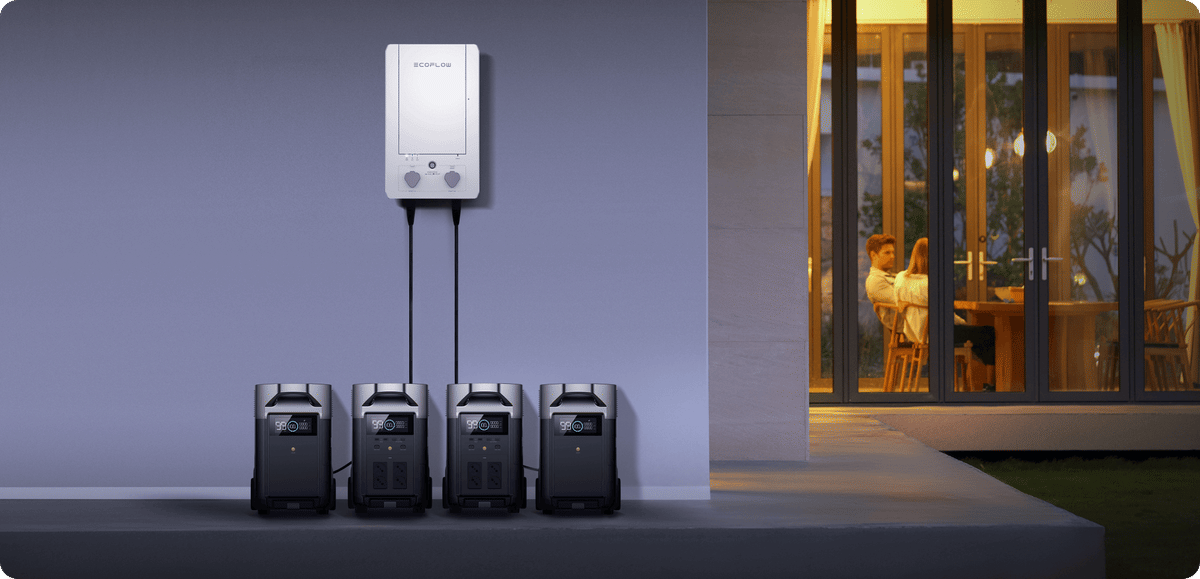
In the numbers provided, we're using the following primary hardware combination. Keep in mind: all of these devices play some part in the overall strategy, even if they're not directly integrated. There are also other devices, but they are largely incidental (i.e. UPS) usage.
EcoFlow Smart Home Panel 2
(3) DELTA Pro 3 Battery Units with (4) DELTA Pro Extra Batteries
(3) Renogy 400w solar blankets
(2) DELTA Pro Battery Units
(1) DELTA 3 Max Plus with (1) DELTA 2 Max Extra Battery
(1) DELTA 2 Max with (1) DELTA 2 Max Extra Battery
(1) BLUETTI AC200L
In the event of an emergency or extended outage, there is also a Smart Generator 4000 with a 30lb propane tank, which estimates at around ~36kWh of runtime additional to the batteries when used. The Smart Generator is theoretically strong enough to power the entire home if the HVAC subpanel circuit were disabled, but more likely it would just be used to charge the DELTA Pro 3 units individually, so that we can tell when power has been restored.
The breakout then works as follows:
| Great Room (4kWh of capacity) | The DELTA 3 Max Plus runs all of the internet and networking infrastructure during the day. It recharges every 2 days or as needed. |
| Kitchen (3.6kWh of capacity) | A DELTA Pro runs all of the kitchen appliances (yes, all of them!) during the day. It recharges every evening off-peak. |
| Basement - Standalone (7.6kWh of capacity) | A DELTA Pro runs the dehumidifier and associated heating element when needed. It runs down to backup level, then powers from the Smart Home Panel 2.
The DELTA 2 Max runs the sump controller when needed. It recharges every evening off-peak. |
| Upstairs South (2kWh of capacity) | The BLUETTI is in charge of running a space dehumidifier in a problem room until the root cause can be identified and corrected; then it will be reassigned to the garage to handle the 120v EV charger which is low risk and only engaged on the weekends. The BLUETTI is a replacement for a unit that failed under mysterious circumstances while assigned to the sump controller, and thus the brand cannot be trusted with anything critical. |
| Basement - Smart Home Panel 2 (28kWh of capacity) | The Smart Home Panel 2 powers all home circuits, including the garage, except for the dryer (which is only ever run in the evenings and/or weekends) and one outlet in the main bathroom (which is hardly ever used and is mostly off-peak usage). Two of the three DELTA Pro 3s (the ones with lesser capacity) have Renogy solar connected to offset consumption when solar energy is peaking, which gives an additional ~2kWh-3kWh or so of capacity. All HVAC equipment comes in through a single 60a 240v breaker from a subpanel. The subpanel includes the AC, furnace blower and a steam humidifier. And yes, the Smart Home Panel 2 with DELTA Pro 3's can easily run a modern efficient outdoor AC. |
This follows basically a hub-spoke design. The so-called "satellite" units (everything except the Smart Home Panel 2) offload the vast majority of consumption during the on-peak period and take pressure off of the basement capacity that the Panel 2 manages. That capacity is reserved for the true heavy hitters, such as the steam humidifier (~2-3kWh when it runs) and the AC (~2kWh when it runs) for now. All other appliances that would normally be heavy hitters (i.e. the water heater) are gas, and thus only take a few watts when running.
The goal is not to run on battery all day. It's to run for the TOU period, which is 12 hours. This is where the math comes in handy.
For just the panel, at 28kWh of capacity, it puts it just over 2kW per hour of consumption available, on average. On moderate days, where no-or-minimal humidifier and AC are needed, this capacity can easily cover the day. On extreme days - especially with the humidifier - it's possible to run out of capacity before the 12 hour mark if the solar energy wasn't enough to offset it. Once we've upped the capacity to 36kWh max, it won't be an issue anymore; but consider that the Smart Home Panel 2 reserves 10% of capacity on each unit. So you effectively only get 33.3kWh with DELTA Pro 3 units. Still enough for our use especially in summer, where the solar energy can generate (if we want) between 400w-800w per DELTA Pro 3 unit, or even higher if we invest in the wiring.
How That Translates To The Bill
A picture speaks volumes:
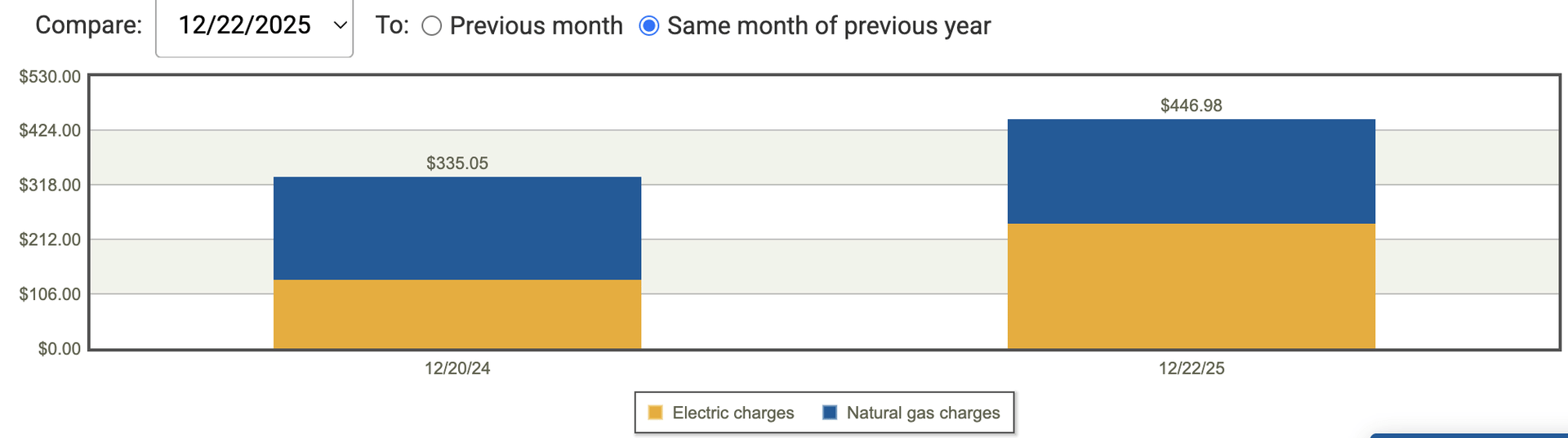
This compares December 2024, when we didn't have the Smart Home Panel 2 or the vast majority of satellite units, to December 2025. The steam humidifier was added in November 2025. So the bill went up by ~$110, the vast majority of that being electric. But this graph is a bit misleading. For you see, the December 2025 bill would have been at least $250 higher without TOU. (we say "at least" because gas appliance replacements contributed to bill shifts on the gas side as well - but we're only focusing on electric for this writeup.)
Why?
Because of the increased consumption. Here's that numbers breakdown:
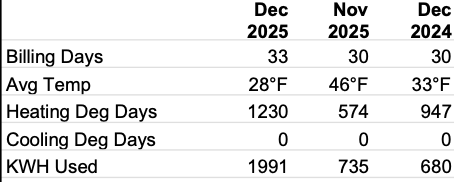
Notice the 3x increase in kWh used. The vast majority of that added amount is the steam humidifier, easily. Yet despite a 3x increase in consumption (necessarily so), it was only a relatively minor bill increase. That's because roughly ~95% of it was shifted to off-peak pricing using the above hub-spoke design - the only time the grid gets touched is when recharging batteries (which happens off peak or weekends only) or for the dryer which is also only run off-peak. The other small amount that's on-peak are situations where the capacity wasn't sufficient vs. demand.
If you're a numbers person, here's that explanation using winter - December 2025 numbers:

And here's winter - December 2024, when we didn't have TOU on:

Over 3x the consumption, yet only ~$110 higher. TOU alone can't realize that savings unless you don't run anything during the normal day. That's where the batteries come in: you charge when the rates are low, then you run off the batteries - not the grid - during the day.
That's peak shedding.
But what's the investment to do that?
That's the important question. You see the bill amounts above. It's easy to justify investments to save when you can understand where you're getting ripped off.
All of our EcoFlow units, including the ones not listed above, except for one, were bought at steep discounts. Still not cheap as an investment, and we bought them all over time, not all up front. This was to measure what it would take to get to the maximum savings.
EcoFlow Smart Home Panel 2 - ~$5000 installed and permitted including all circuits and the subpanel
(3) DELTA Pro 3 Units with (4) DELTA Pro Extra Batteries - $4800 for the Pro 3s, $4400 for the Pro Extra Batteries
(3) Renogy 400w solar blankets - $1200
(2) DELTA Pro Units - $3000
(1) DELTA 3 Max Plus with (1) DELTA 2 Max Extra Battery - $1800
(1) DELTA 2 Max with (1) DELTA 2 Max Extra Battery - $1600
(1) BLUETTI AC200L - $1300
Realistically, the only critical costs (in terms of the highest consuming devices) are bold above. So that would be the minimum: very near $15k all told.
You could go all-in with DELTA Pro Ultra and forego the satellite units. But you're still going to end up very near the $15k - $20k mark depending on your expected consumption. Also keep in mind: the DELTA Pro Ultra's batteries are only reusable with the X model, whereas the other EcoFlow units can interchange their Extra Batteries. Meaning you can start with something like a DELTA Pro (which by itself can run quite a few things) and build up from there much cheaper than it would be to go all-in on a Smart Home Panel 2 right away, for example.
In this region there are basically 5 months of winter (steam humidifier), 5 months of summer (AC and dehumidifiers). So 10 months of the most extreme of use. Excluding the solar panels that means the necessary capacity can be properly calculated using both of those seasons. In our case the winter will be worse than summer, because the steam humidifier peaks at almost 2x the energy that the AC does. So the numbers below are based on the worst case scenario.
Assuming 5 months of $250 savings per, that's $1250. SO that's winter. Let's look at summer-to-come. Here's August 2025, the highest consumption of summer:

This is with TOU enabled but no Smart Home Panel 2, meaning the 550kWh on peak is almost all AC and likely the basement dehumidifier (~600w).
The AC uses roughly half of what the steam humidifier does and we can see that the total numbers, when on-peak is doubled, get very close to the winter numbers.
So if we take this 1681 number and calculate without TOU and without the customer charge, we get $288.36. The above total (without the customer charge) is $266.01. So not much saved at all by going with TOU alone (which is why peak shedding when done correctly is so powerful), because the on peak charge is so high that once you exceed ~20% of your total consumption, it starts to not be that good of a deal.
But if we can peak shed it to match the winter performance - which was 5% of total - we get $188.57 - almost $100 saved every month over the non TOU rate. Assuming 5 months of $100 savings per, that's $500.
So $1750 savings each year - without using the Generator. The 30lb propane tank took about $20 to fill up and should give about 36kWh worth of runtime, which is enough for one day's worth of run; so using straightline math, the grid equivalent on peak for that same 36kWh is $9, meaning it's significantly cheaper to run grid on peak than it would be to run Generator. So the Generator (despite EcoFlow's marketing) is really just for emergencies, not to support peak shedding. Which means the Generator should not be considered in ROI calculation.
The real goal of peak shedding is twofold.
First, your on peak consumption should really be no more than 10% of the total consumption to make it truly worth it.
Second, implementing as much solar as possible to lower the numbers helps significantly. The ultimate goal is to not touch the grid unless you need to and only then during off peak pricing hours, but whatever other source you use should be ultimately cheaper per day than the grid would have been. This is where the ROI gets a bit tricky.
With basic numbers, you're looking at a 10-year minimum ROI if you used the above hardware, which is arguably the bare minimum possible for an abnormal pattern and use. However, that ROI gets slimmer if you live in an area with significant solar energy such that you can deploy enough panels to offset the amount of recharge. The above numbers make minimal use of solar at best; so they represent the worst case scenario. Some areas can net zero off of solar; consider the cost of the panels if you're trying to do that.
A $1600 investment can yield up to 1600kWh of solar energy; but is a dollar per killowatt worth it if your on peak price is 27 cents per kilowatt? Only if you can fully absorb the on peak with that investment, and 100% nullify it, by collecting that much solar energy for the vast majority of the 12-hour TOU period, which is unlikely. If you have 33kWh of capacity and can generate a fairly constant 1600kWh of solar, you're effectively upping your runtime to over 52kWh, and assuming you can keep that up - Arizona, for example - then it's entirely plausible that you not only negate the on peak, but cut into the off peak as well.
Just remember though: the upfront investment will be substantial no matter what. The ROI length will depend solely on how much you have to touch that grid. The more you spend up front, the less you need to touch the grid.